
Robeson Scorns Them

Ran across the following in the March issue of Harper’s—Paul Robeson testifying before the House Un-American Activities Committee in 1956—a mere snippit that jogged my memory a little, reminding me that there were once brave people among the chattering, thoughtless mob who actually had the gumption to stand up and speak truth to power.
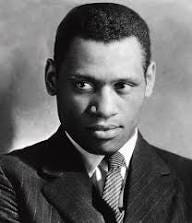
Robeson was an internationally acclaimed concert performer, actor, and political activist. During the red scare era, he was blacklisted for his political activities, for refusing to denounce Russia, repudiate Communism or give up the names of party members, arguing that the Committee’s insistence violated his Constitutional right of free speech. His counterparts today are those Palestinian students at Columbia, Cornell, and other prominent universities, denounced as “anti-Semitic” by our government for speaking up against the genocide in their homeland, then picked up and deported. It would be hard to imagine someone of Robeson’s stature and guiding principles not standing with those students, but instead choosing to remain mute in the face of this fascist take-over of our country.
He certainly did not stay silent then. Along with his blacklisting, his passport was also withheld, which meant that he could not even travel to Europe, where he had been free to earn as an actor and singer. Robeson was in the original cast of Showboat, both in London and America, where he played the role of Joe. His rendition of Ol’ Man River was the benchmark for future performers of the song. When he sang it on Broadway in 1932, the audience leaped to their feet cheering and applauding, thereby stopping the show. He sang it again, with the same result. So he sang it a third time. Edna Ferber noted, “I have never seen an ovation like that given any figure of the stage.”
In 1958, the Supreme Court ruled that a citizens’ right to travel could not be taken away without due process, and his passport was returned.
Few Americans alive today can conceive of the courage it took for Robeson, a black man, to stand up to an all-white government committee--undoubtedly pockmarked with bigots, such as Gordon H. Scherer and Francis E. Walter; but more than that, he denounced them to their faces in language far more eloquent than that to which they were likely accustomed. . .
MR. SCHERER: Why do you not stay in Russia?
MR. ROBESON: Because my father was a slave, and my people died to build this country, and I am going to stay here, and have a part of it just like you. And no Fascist-minded people will drive me from it. Is that clear? I am for peace with the Soviet Union, and I am for peace with China, and I am not for peace or friendship with the Fascist Franco, and I am not for peace with Fascist Nazi Germans. I am for peace with decent people.
MR. SCHERER: You are here because you are promoting the Communist cause.
MR. ROBESON: I am here because I am opposing the neo-Fascist cause which I see arising in these committees. You are like the Alien [and] Sedition Act, and Jefferson could be sitting here, and Frederick Douglass could be sitting here, and Eugene Debs could be here. . . .
. . . .As noted in Harper’s, this piece was collected in A Treacherous Secret Agent: How Literature Spoke Truth to Power During the Red Scare, by Marjorie Garber, published in March by Yale University Press.
PAUL ROBESON: To whom am I talking?
FRANCIS E. WALTER: You are speaking to the chairman of this committee.
ROBESON: Mr. Walter?
WALTER: Yes.
ROBESON: The Pennsylvania Walter?
WALTER: That is right.
ROBESON: Representative of the steelworkers?
WALTER: That is right.
ROBESON: Of the coal-mining workers and not United States Steel, by any chance? A great patriot.
WALTER: That is right.
ROBESON: You are the author of all the bills that are going to keep all kinds of decent people out of the country.
WALTER: No, only your kind.
ROBESON: Colored people like myself, from the West Indies and all kinds. And just the Teutonic Anglo-Saxon stock that you would let come in.
WALTER: We are trying to make it easier to get rid of your kind, too.
ROBESON: You do not want any colored people to come in?
RICHARD ARENS: Now, I would invite your attention, if you please, to the Daily Worker of June 29, 1949, with reference to a get-together with you and Ben Davis. Do you know Ben Davis?
ROBESON: One of my dearest friends, one of the finest Americans you can imagine, born of a fine family, who went to Amherst and was a great man.
WALTER: The answer is yes?
ROBESON: Nothing could make me prouder than to know him.
WALTER: That answers the question.
ARENS: Did I understand you to laud his patriotism?
ROBESON: I say that he is as patriotic an American as there can be, and you gentlemen belong with the Alien and Sedition Acts, and you are the nonpatriots, and you are the un-Americans, and you ought to be ashamed of yourselves.
WALTER: Just a minute. The hearing is now adjourned.
ROBESON: I should think it should be.
WALTER: I have endured all of this that I can.
ROBESON: Can I read my statement?
WALTER: No, you cannot read it. The meeting is adjourned.
ROBESON: I should think it would be, and you should adjourn this forever—that is what I would say.*
*For a look at Robeson’s full testimony, see History Matters, George Mason University.
On March 27, Mohamad Safa, a UN diplomat of twelve years, resigned his position, and issued a warning that the U.S. may be preparing to use a nuclear weapon against Iran, a country that possesses no nukes and had no plan to make them. Tehran is a city of ten million people.
This has received almost no attention in the mainstream media.
. . .And the question is, where are the voices today that have the courage to speak truth to power, as Robeson did, especially now, at a time when deranged hooligans have brought us to the brink of world ending war? Be they male, female, white, black, Hispanic, religious or non-religious. . .where are they? I call out even those accustomed to sitting on the sidelines while ruthless butchery is enacted before their eyes, and have the stomach to call their non-participation virtuous. Try, as you may, there is no principle, no fine sounding “ethic” you can cite that sanctions your silence and absolves you of responsibility in the face of injustice so dire that it could spell the end of humanity as we know it.
The time for silence is past. The time to speak is now.

WHEW! This gave me chills, Grayson. Wonderful to honor and remember those who spoke truth to power.
Thank you
Thanks, my friend.